Mistakes to Avoid When Deciding Where To Put Your Container Garden
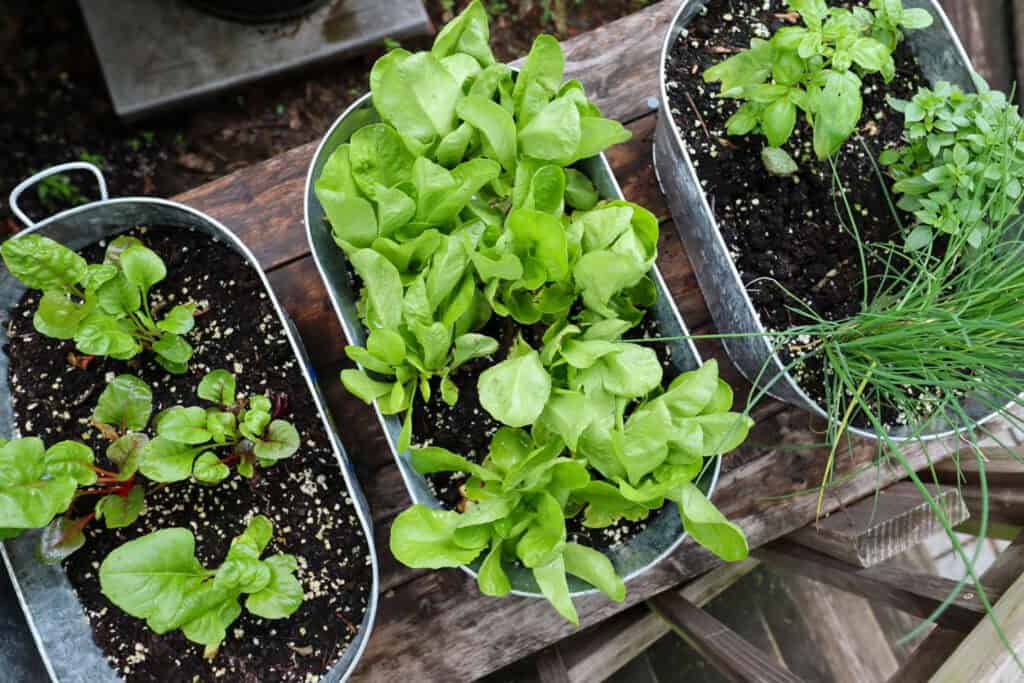
Whether you have a large property or just a small patio, I believe that anyone can grow a container vegetable garden.
I live in an urban neighborhood on a pretty small property.
Despite that, I have over twenty containers of varying sizes that I grow vegetables in.
And after seven years of vegetable gardening, I’ve made plenty of mistakes.
A mistake you can make early on is around where you’re going to actually put your container garden. Fortunately, that’s easily avoidable.
In this article, I’m sharing mistakes to avoid when deciding where on your property to place a container vegetable garden.
Mistake #1: Sunlight
Sunlight is incredibly important to vegetable plant growth.
Many vegetable plants require six hours of sunlight with eight hours being ideal.
Note that I didn’t say all vegetable plants – there are some that can grow in shade and partial-shade.
I know this because I have a beautiful tree canopy over much of my back deck, which is great for sweaty summer afternoons, but not great for growing vegetables.
Fortunately, I’ve found some vegetables that do well in the shade, like Swiss Chard.
So, if you have a lot of shade, don’t be discouraged.
However, when you are choosing where to put your containers, if you have a sunny spot versus a shaded spot, I’d opt for the sunlight.
Now, you need to keep in mind that sunlight changes over the course of the day and the growing season.
What I recommend is on a sunny day, take a picture of your space every two to three hours to see how much sunlight that area truly gets.
You also have to keep in mind that the sun’s placement in the sky changes over the course of the year, and can vary quite a bit depending on where you live.
For this reason, I like gardening in containers that have wheels. I just move my containers around to where the sunlight is!
If you’re a new gardener, I recommend starting small with containers that are movable. Then, see how the sunlight on your property changes over the course of the growing seasons.
This way, you can make an informed decision before installing a container that is not easily movable.
Mistake #2: Water Supply
Whether you will be watering with a hose, watering can, or drip irrigation, you’ll want to make sure you place your container garden somewhere easily accessible to the water supply.
If your hose is on the north side of your home and your garden is on the south side, that could be a problem.
And if you plan to lug out a watering can each day, you should have the place where you fill it be somewhat close to your containers.
So, take note of where your water supply will be, and try to get as close to that as possible.
Mistake #3: Ease of Access
I have over twenty containers of varying sizes around my property.
And if I’m being honest, the ones closest to my back deck, which is the house entrance I mainly use, get the most attention.
And that makes sense – we have established routines we may not even be aware of, including where you walk in and around your home.
So, I’ve been intentional with putting more of my containers on the back deck.
It’s an absolute highlight for me when I am able to walk right out of my kitchen onto my back deck and snip off some herbs for a dish I am making.
I encourage you to consider this when planning your garden. Which location will you be more likely to pass by on a daily basis? That might be an ideal area!
Mistake #4: What’s Beneath the Container
You’ll want to give careful consideration to what is beneath your container garden.
Ideally, you’ll be watering it daily, and what that means is the water will drain to whatever is beneath the container.
Depending on what is beneath it – wood, concrete, tile, etc. – it could potentially stain or rot.
You’ll also need to consider the weight of your container. The larger ones can be pretty heavy.
Personally, my wooden deck is older, and I’ve definitely had some issues where my heavier containers have weakened the wood.
I’ve been able to move them off the weaker parts of the deck, so it’s been fine, but it’s something to consider if you’re starting a new container bed.
