Perlite vs Vermiculite for Vegetable Gardening: What’s Best?

If you’ve ever looked up how to make your own potting mix, you’ve probably seen both perlite and vermiculite listed in the ingredients and thought: ok, but do I really need both?
That’s a fair question – and one that I had in my early container vegetable gardening days.
They look somewhat similar in a bag. They both get mixed into soil. And they both get talked about like they’re essential.
But perlite and vermiculite are not the same.
Once you understand the difference, it gets much easier to decide which one makes sense for your garden, your containers, and the kinds of vegetables you’re growing.
Here’s what each one does, when to use it, and how I’d think about perlite vs. vermiculite if you’re gardening in containers, raised beds, or other small spaces.
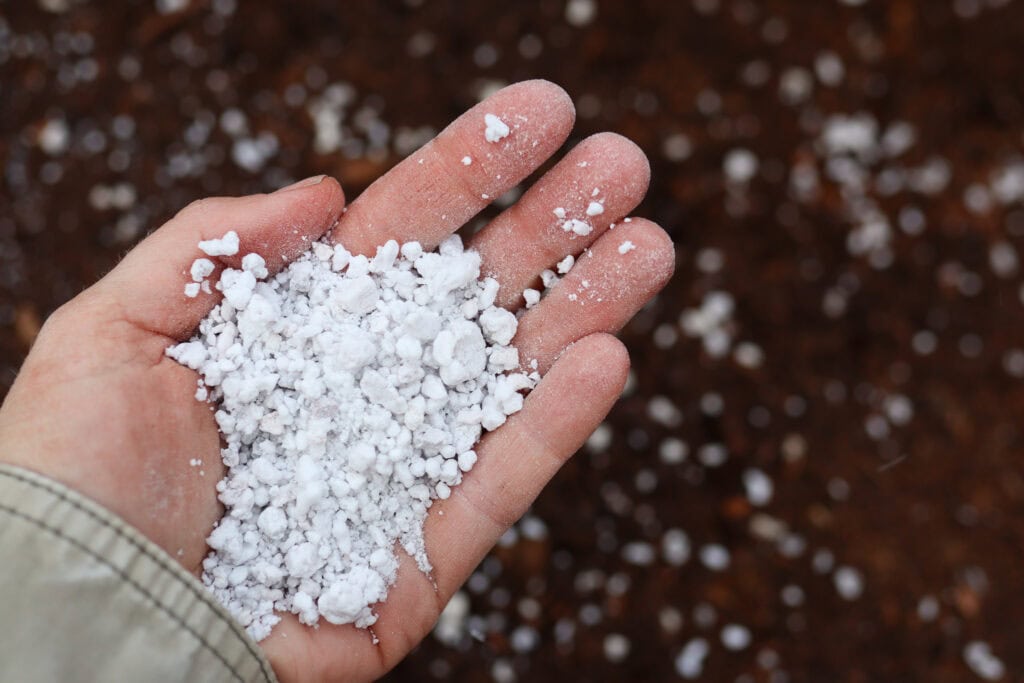
What Is Perlite?
Perlite is a lightweight material made from volcanic glass that has been heated until it expands.
In gardening, it looks like little white pieces scattered through potting mix.
Its main job is to improve drainage and aeration.
That means perlite helps create tiny air spaces in the soil so water can move through more freely and roots have better access to oxygen.
This is especially important in container gardening, where soil can get compacted and soggy much faster than it does in an in-ground garden.
If you tend to overwater, use containers without a lot of soil volume, or grow crops that hate wet feet, perlite is usually the more important ingredient.

What Is Vermiculite?
Vermiculite is a naturally occurring mineral that expands when heated.
It has a softer, more layered texture than perlite and usually looks brownish-gold.
Its main job is to hold moisture.
Vermiculite absorbs water and helps keep it available in the soil longer. It can also help hold onto some nutrients, which can be useful in mixes that dry out quickly.
If your containers dry out fast, you live in a very hot climate, or you’re starting seeds indoors, vermiculite can be helpful.
Perlite vs. Vermiculite: The Main Difference
The simplest way to think about it is this:
Perlite helps soil drain faster.
Vermiculite helps soil stay moist longer.
That’s the big distinction.
So if you’re deciding between perlite vs. vermiculite, the right choice depends less on which one is “better” and more on what problem you’re trying to solve.
Which Is Better for Vegetable Gardening?
For most container vegetable gardens, perlite is usually the more useful of the two.
That’s because a lot of vegetable gardening problems in containers come back to poor drainage and lack of oxygen around the roots.
When potting mix gets too dense or stays too wet, plants struggle. Growth slows down. Leaves yellow. Roots can start to rot.
And suddenly the issue looks like a fertilizer problem when it’s really a soil structure problem.
Perlite helps prevent that.
Vermiculite can still be useful, but in most vegetable containers, you usually want to be careful not to create a mix that stays wet for too long, especially for crops like tomatoes, peppers, herbs, and strawberries.

When to Use Perlite
Perlite is a great choice when you want a potting mix to stay loose and drain well.
It’s especially helpful for:
- Tomatoes
- Peppers
- Herbs
- Eggplant
- Strawberries
- Containers that don’t dry out quickly
- Heavy potting mixes that need more airflow
If you’re making your own potting soil for vegetables, perlite is often the ingredient that keeps the mix from becoming too dense over time. I personally combine it with equal parts coco coir and compost.
When to Use Vermiculite
Vermiculite makes more sense when moisture retention is the priority.
It’s often useful for:
- Seed starting mixes
- Small seed trays or cell packs that dry out fast
- Gardens in very hot or windy conditions
- Potting mixes that seem to dry out almost immediately
Can You Use Both Perlite and Vermiculite Together?
Yes, absolutely.
In some potting mixes, using both makes sense because each one brings something different to the mix. Perlite adds drainage and air space, while vermiculite adds moisture retention.
That said, you don’t always need both.
For a lot of home vegetable gardeners, especially those making their own container mix, perlite is the one I would prioritize first. Then, if you know your containers dry out too fast or you’re building a seed-starting mix, vermiculite can be added more intentionally.
Perlite vs. Vermiculite for Seed Starting
This is one area where vermiculite often shines.
Seed starting mixes need to stay evenly moist, especially while seeds are germinating. For me, this is the hardest part of seed starting.
Fortunately, vermiculite helps with that! It holds moisture more effectively than perlite, which can make it useful in seed trays and propagation setups.
Perlite still has value in seed starting because it keeps the mix airy and prevents it from getting too dense.
So for seed starting, a mix that includes both can work really well.
Perlite vs. Vermiculite for Raised Beds
In raised beds, neither one is usually as essential as it is in containers.
That’s because raised beds typically hold much more volume of soil, and if they’re built properly with a good soil blend, drainage and moisture balance come more from the overall soil composition than from one amendment like perlite or vermiculite.
If you’re filling an entire raised bed, compost and other organic materials usually matter far more.
Perlite or vermiculite can still be added in small amounts, but for most raised bed gardeners, they’re not the first thing I’d spend money on.
Final Thoughts on Perlite vs. Vermiculite
When it comes to perlite vs. vermiculite, there isn’t one universal winner.
They do different things.
Perlite is better for drainage and aeration. Vermiculite is better for moisture retention.
For most container vegetable gardeners, perlite is the more important one to keep on hand. Vermiculite has its place too, especially for seed starting and mixes that dry out too quickly.
The key is knowing what your soil needs and using these ingredients on purpose, not just because a recipe told you to.
